By André Wagner
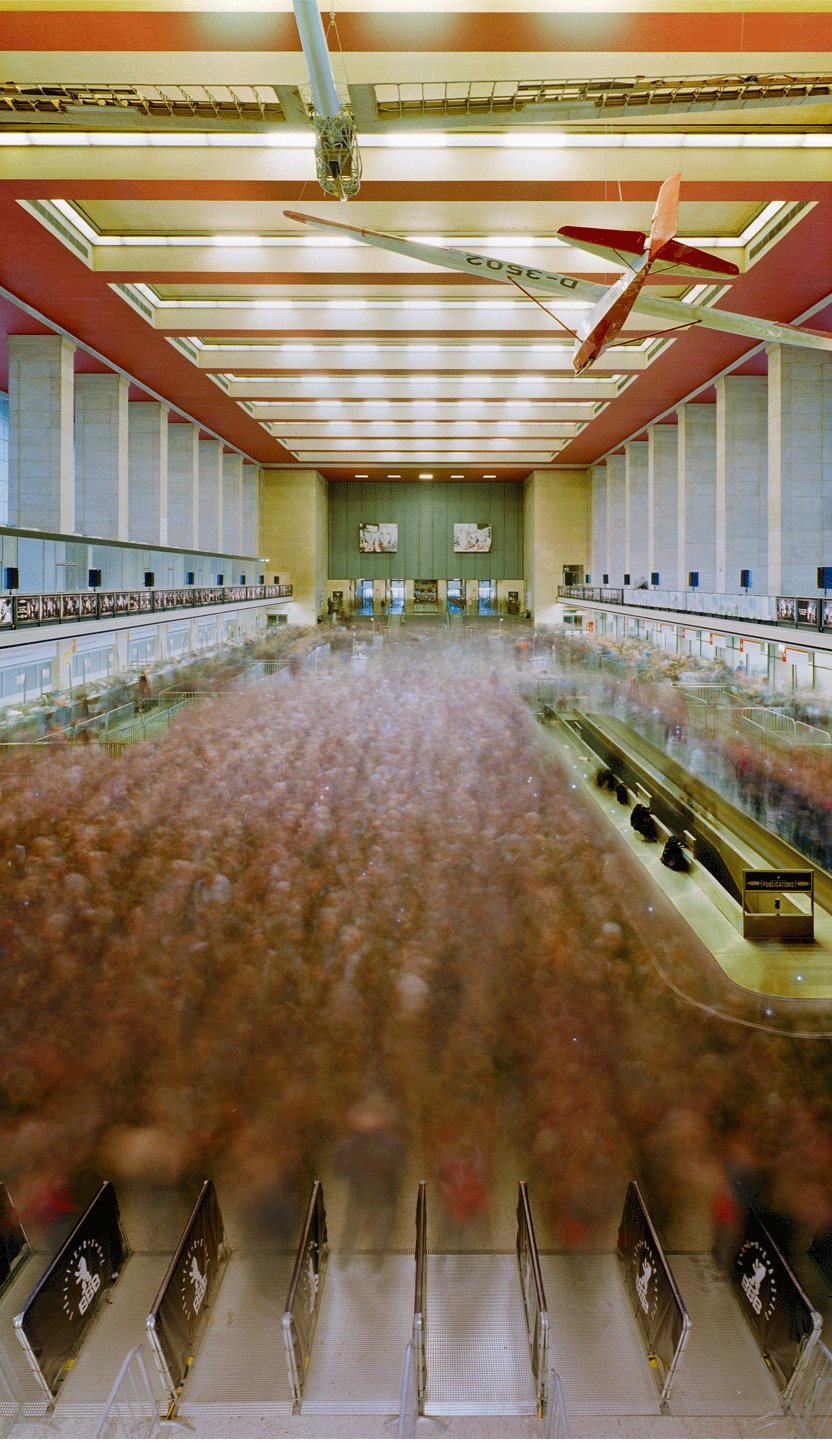
In 2011, I photographed the opening of Bread & Butter in Berlin-Tempelhof. Thousands of people were waiting to get in. Then the doors opened and the crowd began to move. For my work Opening, I recorded both moments in long exposures on film and later combined the two photographs digitally into a single image. Stand in front of the print today and you can see two moments in time. Even if you have never heard of the event, you know the tension just before a door opens. View Opening
A photograph like this gives us more to go on than a price chart when we ask what lends a collection lasting value. A photograph can bring something to a collection that was missing until then. Its financial value also depends on which print you acquire, how well its provenance is documented and whether future buyers will want that particular version. Each question deserves a closer look.
What makes a photograph timeless and worth collecting?
A photograph can feel timeless precisely because it belongs so unmistakably to its own time. With Opening, we can name the year, the place and the occasion. For me, the image gains depth when those facts give rise to another question. What does waiting look like when thousands of people are waiting together? And what changes the moment they are free to move? The long exposure gives their movement a form. The idea is there in the image itself.
Another artist revealed the relationship between a subject and the making of a print in a very different way. Ansel Adams took Moonrise, Hernandez, New Mexico in 1941. As the Museum of Modern Art describes, he gave later prints greater contrast. The sky grew darker and the moon stood out more brightly. Compare two versions and you see the same place, captured in the same exposure, with a different balance of light and dark. Knowing which print you are looking at becomes part of the pleasure of looking. MoMA on Ansel Adams’s Moonrise
Try a small experiment when choosing a work. Look at the photograph before you read about it. Where does your eye linger? Then read how the image was made and return to that very spot. Perhaps you can now see a choice the artist made that you missed the first time. If you find yourself wanting to look again a few days later, you have found a reason of your own to live with the work.
Which photographs give a collection greater depth?
Imagine a collection of urban photographs. It shows façades, long views down streets and public squares, most of them empty. An image of a crowd waiting could change the way the entire group reads on the wall. Suddenly you see how architecture directs people in the photographs you already own. Where is the entrance? Who is free to move? Why does an empty forecourt suddenly look like a stage?
For me, that is one way a collection gains lasting value. A single well-chosen acquisition can change how you see several works. If you already collect photography, you can try this before buying. Place a reproduction of the new work beside two photographs you own. Can you say what you are seeing in them for the first time? The answer tells you more about what the purchase means for your collection than the edition size alone.
What do recent market figures tell us about fine art photography?
Photography has gained ground in the art trade. In the Art Basel and UBS Art Market Report 2026, Arts Economics puts photography’s share of sales by value among the fine art dealers surveyed at six per cent in 2025, up from three per cent in 2024. Photography accounted for a larger share of those dealers’ turnover. To see how the price of any individual work changed between sales, you would need the sale records for that work. Art Basel and UBS, Art Market Report 2026, pp. 66–67
If resale matters to you, look for prices that comparable prints have actually sold for. Are you comparing the same work, size, printing process, edition and condition? A large exhibition print and a small edition of the same image can fetch very different prices. Where only asking prices are available, the amount a future buyer might pay remains an open question.
A work’s connection to a museum also calls for precision. In 2017, I donated a print of Opening to the Kunstmuseum Moritzburg Halle (Saale). The museum’s copy is a framed ChromaLuxe print measuring 180 × 105 cm. The gift is part of the work’s history. Anyone who acquires another print can point to the presence of the work in that collection. Valuing their own print requires other points of comparison. Opening and its collection history
Four questions I would ask before buying
- Which version am I buying? Ask when the photograph was taken and when the print was made, what the image dimensions are, and which process and materials were used. Many years can pass between making an exposure and making a print.
- What does the edition size cover? Ask whether the edition applies to this size or to the image across all sizes. Ask about other formats and the number of artist’s proofs. That will tell you what a notation such as “3/7” means for this particular work.
- What documentation comes with my print? The invoice, any certificate and photographs of the signature, reverse and labels should all be traceable to the same print. If you sell it later, those records will help the next owner establish where it came from.
- What does the print look like in person, and where will it hang? Whenever possible, inspect the surface, edges and frame in person. Take a look at the light where you plan to hang it, too. The Canadian Conservation Institute recommends protecting photographs from direct sunlight and strong light. Dyes in colour photographs are particularly susceptible to fading. Canadian Conservation Institute on caring for photographs
Finally, I would take the photograph back to the wall where it will actually hang. Imagine an ordinary Tuesday, long after you have bought it. You walk past the picture. What makes you stop? Perhaps this time the first thing you notice in the waiting crowd at Tempelhof is the movement. Perhaps, in the photograph beside it, you notice the stillness for the first time. That is a gain you can experience for yourself.